E-commerce · Custom software · AWS
Rebuilding an 84-year-old repair business for the next era.
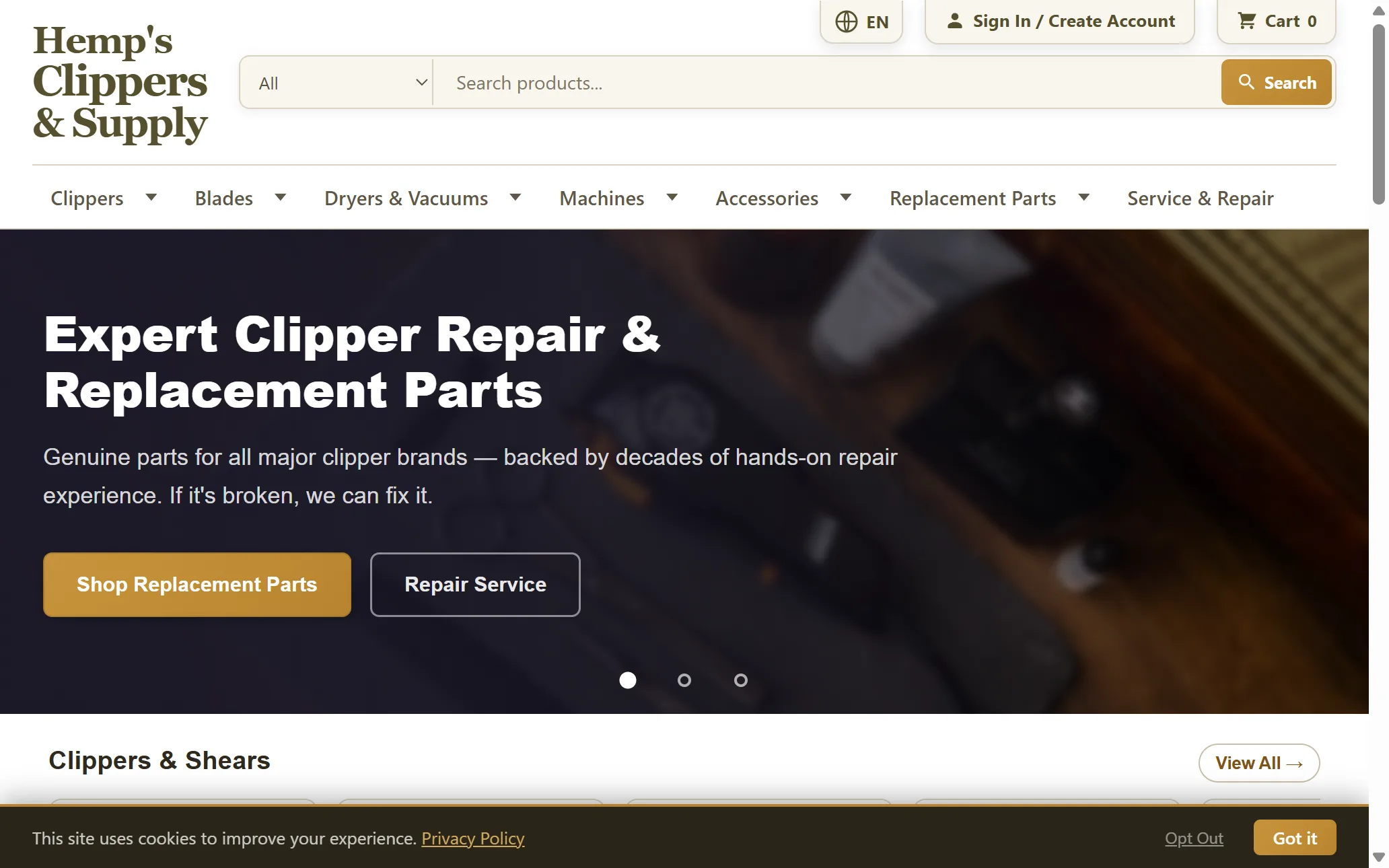
Hemp's Clippers & Supply has served grooming and repair professionals since 1942. We transformed its ColdFusion-era storefront into a modern commerce and operations platform while preserving the product knowledge, repair relationships, and search history that made the business valuable.
- Year
- 2026
- Scope
- Strategy & UXE-commerceCustomer platformCloud infrastructure
- Live site
- clipperrepair.com ↗
- Since 1942
- A multigenerational specialty business with decades of customer trust.
- 2,000+
- Legacy URLs cataloged and assigned a migration destination.
- One platform
- Storefront, customer tools, repair discovery, and staff operations.
01 / The assignment
Modernize the system without flattening the expertise.
This was not a cosmetic redesign. The old site carried years of product identifiers, model relationships, replacement diagrams, bookmarked links, and search visibility. Behind it sat workflows that depended on staff knowing where every part and order belonged.
The new platform had to make a highly specialized catalog easier for customers to navigate, give returning buyers a useful account experience, and give staff better tools without forcing the business into a generic commerce template.
Preserve hard-won search equity and old customer bookmarks.
Connect machines, diagrams, and replacement parts clearly.
Support retail and wholesale customer relationships.
Reduce friction in everyday catalog and order administration.
Before / after
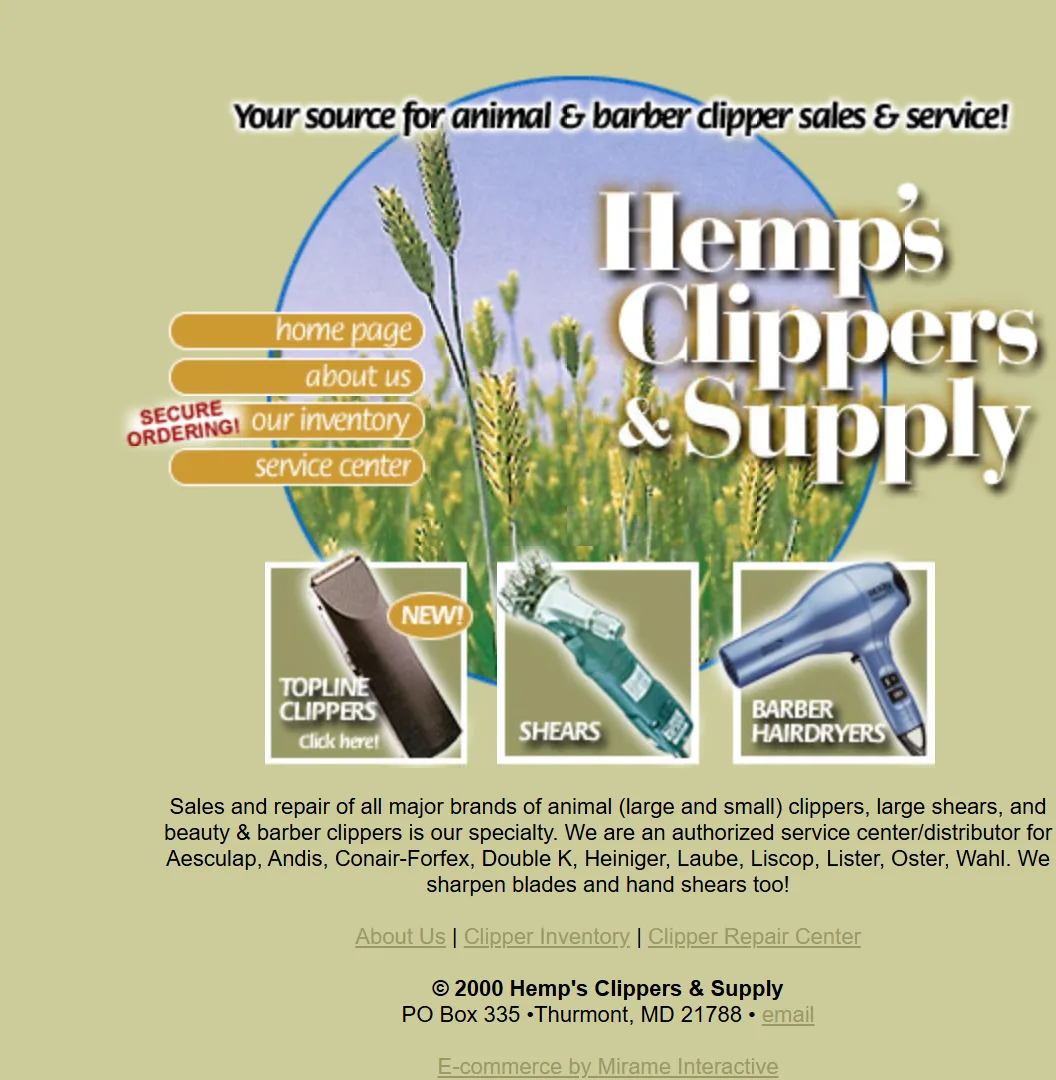
From a fixed image-sliced homepage to a responsive commerce system.
The original website launched in 2000. This January 2006 archive captures it six years into service, and much of the same visual structure and navigation remained recognizable for nearly two more decades. The latest redesign was a generational modernization, not a routine refresh.
02 / Migration
The old catalog was a map of customer intent.
A legacy URL is more than technical debris. It may be a repair shop's bookmark, a link from a manufacturer forum, or a search result that has answered the same question for years. We crawled and classified more than 2,000 old destinations before the new information architecture replaced them.
That inventory included hundreds of model-specific parts listings and product pages. Direct matches were assigned clean new destinations, while products without a clear counterpart were flagged for review instead of being silently discarded. Redirect rules now carry old paths into the right category, model, product, or fallback experience.
New links use readable category, brand, model, and product slugs. That makes the site easier to understand, share, maintain, and index without breaking routes customers already knew.
03 / The product
One experience for buying, repairing, and owning equipment.
The storefront is organized around the way professionals actually think: start with a machine, a brand, a job, or a failed part, then move quickly to the right product and supporting information.
Product discovery
Clean category, brand, model, and use-case paths replaced a maze of numeric query-string destinations.
Replacement parts
Model-level diagrams and compatible parts turn specialist repair knowledge into a practical self-service workflow.
Customer accounts
Customers can manage profiles and addresses, review orders, request returns, reorder, and apply for wholesale access.
My Equipment
Saved machines become a personalized hub for compatible parts, diagrams, maintenance notes, and repeat purchasing.
Staff operations
A custom admin workspace brings catalog, inventory, orders, customers, discounts, and content into one system.
Lifecycle messaging
Transactional email supports verification, orders, returns, account changes, and customer follow-up without manual handoffs.
04 / Architecture
Scale the busy moments without carrying a busy server.
The replacement platform uses a hybrid serverless architecture. Stable pages and assets are delivered close to the visitor through a global content network. Dynamic catalog, account, cart, and administration requests are routed to managed services that can expand independently as traffic changes.
Infrastructure is defined as code and released through separate staging and production pipelines. That makes deployments repeatable, keeps review gates explicit, and lets the system evolve without maintaining traditional web servers.
05 / Operations
The storefront is only half the product.
Specialty retail depends on the work behind the order. Staff need to maintain product relationships, inventory, images, customer records, discount rules, and order status without translating every change through a developer.
The custom administration area is built around those responsibilities. It gives the business one operational view while preserving room for new fulfillment and accounting integrations as those workflows are ready to change.
Monitoring, structured release pipelines, and environment separation support the same goal: a platform the business can operate confidently, not simply a website that looks finished on launch day.
06 / The result
A durable foundation for the next generation of the business.
Hemp's now has a responsive commerce experience that treats repair knowledge as a product advantage. Customers can move from equipment to compatible diagrams and parts, keep useful account history, and return to the machines they own. Staff can manage the catalog and customer lifecycle from purpose-built tools.
Just as important, the modernization did not pretend the old site never existed. Its routes were measured, mapped, and carried forward. The result is a platform designed to grow without severing the history that earned customer trust in the first place.
Your next chapter
Your legacy system already contains the blueprint.
We help established businesses preserve what works, untangle what does not, and build a modern platform around the knowledge they have earned.
Start a conversation